Stemcell Science Shop
Principles of Communication Engineering
Principles of Communication Engineering
Couldn't load pickup availability
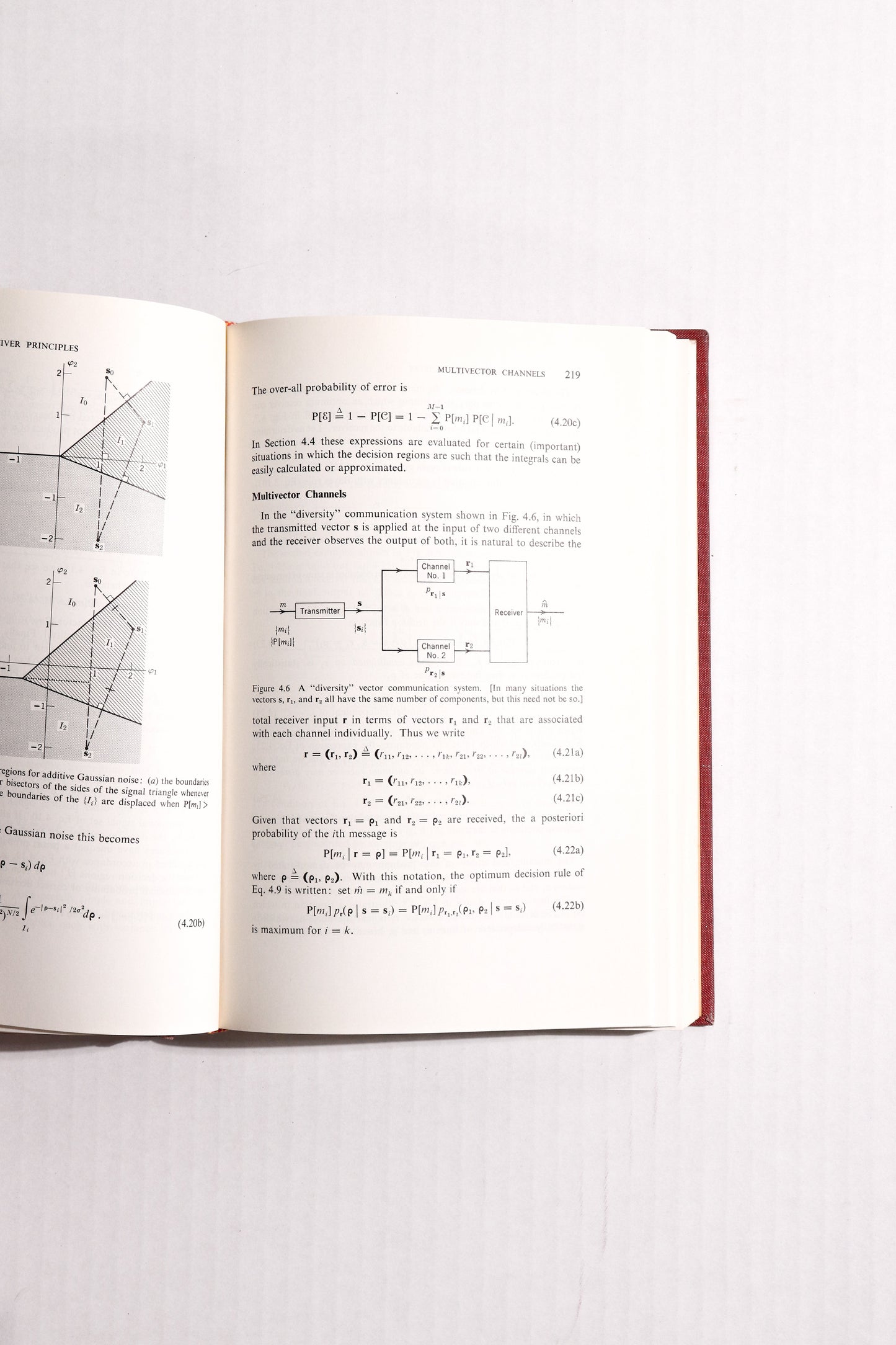
Principles of Communication Engineering; John M. Wozencraft and Irwin Mark Jacobs
1990
This book is a foundational text in communication engineering, providing a rigorous treatment of the principles underlying the transmission of information over communication systems. It is particularly known for its strong mathematical approach and its influence on modern digital communications theory.
The authors begin by introducing the basic concepts of communication systems, including signals, noise, bandwidth, and system components. They emphasize probabilistic models to describe communication channels and the effects of noise on signal transmission.
A central focus of the book is information theory, building on the work of Claude Shannon. Key topics include:
Information content and entropy
Channel capacity and limits of reliable communication
Coding and decoding strategies
The text also covers both analog and digital communication techniques, including:
Modulation methods (amplitude, frequency, and phase modulation)
Detection and estimation theory
Signal representation and transformation
A major strength of the book is its treatment of noise and optimal signal processing, where the authors develop methods for designing systems that minimize errors in the presence of interference.
Mathematical analysis is emphasized throughout, with extensive use of probability theory, random processes, and linear systems to model communication behavior.